| WTI Crude | $72.37/bbl | +0.3% |
| Brent Crude | $75.09/bbl | +0.4% |
| HH Nat Gas | $4.10/MMBtu | +0.2% |
| MB Propane | $1.09/gal | -0.2% |
| 3:2:1 Crack | $19.72/bbl | -3.7% |
That Olympic field hockey turf is pretty sustainable
Brazilian petrochemical company, Braskem, and German chemical company, Covestro, helped make the field hockey turf at the Olympic Games more sustainable.
How they did it:
Braskem takes sugarcane-based ethanol, dehydrates it into ethylene, and polymerizes it into the same polyethylenes you see everywhere. Covestro reacts CO2 with a traditional petroleum-based epoxide to produce a polycarbonate polyol. Braskem's polyethylene is used to make the polyethylene monofilament fibers (fake blades of grass) and Covestro's CO2-based polyol serves as an elastic binder for the granules (the stuff that always gets in your shoes).
Some thoughts:
Of course, the sustainable turf and other green efforts at the Olympics are mostly a marketing ploy and have received mixed reviews. But in any case, the sustainable materials offered by Braskem and Covestro at least serve as an example for the future. So, even if Olympic field hockey isn't your thing, you can at least be enamored by the field itself. Check out the schedule here.
ExxonMobil and SABIC's new plant is almost ready
US-based petroleum company, ExxonMobil, and Saudi Arabian chemical giant, SABIC, have nearly completed the construction of their joint project in Corpus Christi, TX.
Some context:
Just 3 years ago, ExxonMobil and SABIC finalized their plans to form a joint venture for this $10 billion petrochemical project. The project consists of what will be the world's largest ethane cracker (2 million tons per year), an ethylene glycol (MEG) unit, and two polyethylene units (likely HDPE, LDPE, and LLDPE). Construction on the project got started in mid-2019 and is starting to wrap up.
Looking forward:
The companies are expecting to start up the new complex "ahead of schedule, likely in the fourth quarter of 2021.". When the plant starts operating it will use that ethylene (from the cracker) to produce 1.2 million tons of MEG and 1.4 million tons of polyethylene each year. Most of that MEG is used to make antifreeze and PTA for PET. There are seemingly infinite uses for the polyethylene.
Read the press release here.
Toray wants their special PBT to be used for 5G
Japanese chemical company, Toray, has developed a new, higher performance, polybutylene terephthalate (PBT) for applications in the growing 5G communications infrastructure.
5G materials 101:
The high-frequency millimeter-wave technology used for 5G communication requires materials with low dielectric constants to mitigate signal loss. We've seen Indorama offer its PNDA, DuPont's polyimides, and Celanese's LCPs. This market is growing quickly and we'll likely see it evolve in the coming years.
So, what did Toray do?
Toray's new PBT was produced by constraining "the polymer’s molecular motion in the high-frequency range by leveraging polymerization technology to attain a new structure". This new process produces a PBT with dielectric losses that are "40% lower than [that] of conventional PBT".
Read the press release here.
The Reboiler:
- The EIA told us that the US produced fewer CO2 emissions last year than since 1980
- KBR landed a contract to build out Neo Lithium's new lithium carbonate plant
- Shell just invested in a new oilfield in the Gulf of Mexico
- INEOS Styrolution is offering mechanically recycled polystyrene
- New Energy Blue is planning to construct a cellulosic biomass refinery in Iowa
MOTD: benzene
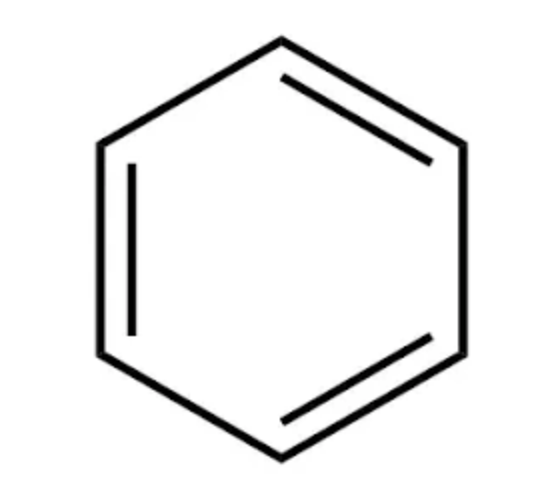
Today's MOTD is a personal favorite… benzene.
First isolated in 1825 by Michael Faraday, nature's hexagon got its name from the hardened tree sap that was used to make the molecule. Benzene is a critical intermediate chemical with extremely toxic properties—which is why you don't microwave styrofoam and why we don't use it to decaffinate coffee anymore.
Today, the world produces something like 60 million tons of benzene each year. Global benzene production is more complex than most chemicals because most of it is produced as a co-product (so supply is based on the demand for other hydrocarbons). Initially, the molecule was produced strictly by the destructive distillation of coal, but today its made by catalytic reforming, toluene hydrodealkylation, or by steam cracking (which produces pygas).
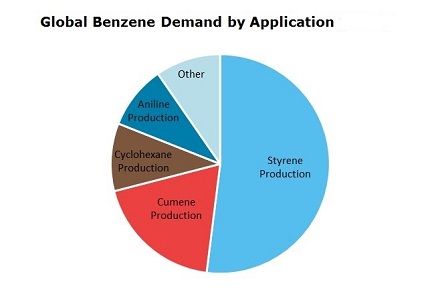
That benzene is used primarily to make styrene (50%), cumene (20%), cyclohexane (15%), and aniline (10%). Here's a percentage breakdown and here's a flow chart of its main derivatives. The main companies producing all this benzene are BASF, CP Chem, , and the other usual suspects.