Good morning. The bit about sunscreens only scratches the surface. If you're particularly interested scroll back up here an give this a read.
| WTI Crude | $71.71/bbl | -1.0% |
| Brent Crude | $74.98/bbl | -1.3% |
| HH Nat Gas | $3.65/MMBtu | -3.7% |
| MB Propane | $1.03/gal | +3.5% |
| 3:2:1 Crack | $20.24/bbl | +1.2% |
BASF's sunscreen chemical expansion
German chemical giant, BASF, has announced that its upcoming UVA-ray blocking chemical expansion in Taiwan will be moved to China.
Catching you up:
Back in August 2020, we talked about BASF's plans to make more diethylamino hydroxybenzoyl hexyl benzoate (DHHB). This molecule (marketed as Uvinul® A Plus) absorbs UVA radiation and is sold to sunscreen manufacturers in the form of granules that are soluble in the cream formulation you know best.
An abbreviated backstory:
While DHHB generally outperforms typical UVA filters commonly used in the US (like avobenzone), the US regulates sunscreen as a drug instead of a cosmetic. Basically, the US's strict safety requirements have made it impossible for new UV ray blocking molecules to hit the market. Surprisingly, despite Europe's reputation for being cautious towards chemicals, the EU is way more chill when it comes to sunscreen regulation.
Zooming out:
The US FDA isn't about to relax its regulation of these molecules—in fact, just a few months ago the FDA announced that pretty much all of the currently approved UV blocking molecules are no longer "generally recognized as safe and effective". Of course, that news is irrelevant for BASF and this upcoming plant in China, because none of what they are planning to make was coming to the US either way.
Read the press release here.
Gevo is getting its customers to preorder
Renewable chemicals company, Gevo, has announed a new capacity reservation agreement with Kolmar for its sustainable aviation fuel (SAF) and bio-based isooctane.
Some context:
In the US, some 40% of all corn produced is fermented to make ethanol. Basically, all of that ethanol is then mixed into gasoline (gasoline is 10% ethanol in the US) because of a law called the RFS. Generally speaking, refiners haven't supported the law because it means they sell 10% less ethanol-free gasoline and it restricts the use of better performing oxygenates (like ETBE) in the fuel.
Okay, so what?
Gevo doesn't want to ferment corn to make ethanol, they want to ferment corn to make isobutanol (using a unique microorganism). After that, they'll dehydrate the isobutanol to isobutylene and then oligomerize it into the C8-C12 hydrocarbons that represent the main component of gasoline (that's the bio-based isooctane) and jet fuel (that's the SAF), respectively.
So, what's the deal here?
Kolmar basically just owns a lot of tanks. The company buys large quantities of fuels and stores them for later resale. Gevo's agreement with them just reflects some of their recent progress.
Read the press release here.
The Reboiler:
- The new Ford Bronco uses some ocean plastic from DSM Engineering Materials
- Aramco and Sumitomo are going to use Axens' ethylene dimerization technology
- Entegris announced plans to build a new semiconductor materials site in Taiwan
- ConocoPhillips is going to sell its Indonesia Assets for $1.355 billion
- ExxonMobil decided to buy a materials company called Materia
MOTD: benzene
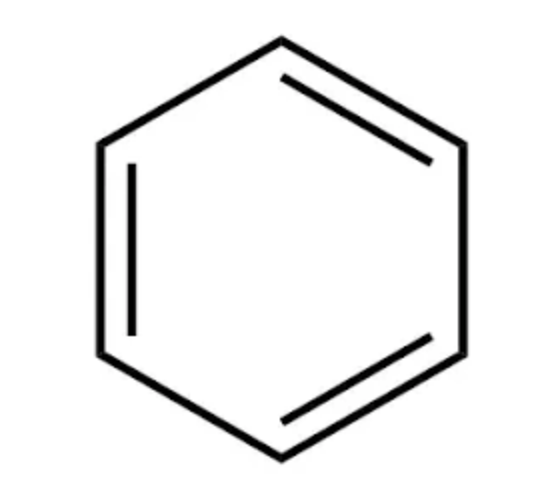
Today's MOTD might be more important than you expect, it's benzene.
First isolated in 1825 by Michael Faraday, nature's hexagon got its name from the hardened tree sap that was used to make the molecule. Benzene is a critical intermediate chemical with extremely toxic properties—which is why you don't microwave styrofoam and why we don't use it to decaffinate coffee anymore.
Today, the world produces something like 60 million tons of benzene each year. Global benzene production is more complex than most chemicals because most of it is produced as a co-product (so supply is based on the demand for other hydrocarbons). Initially, the molecule was produced strictly by the destructive distillation of coal, but today its made by catalytic reforming, toluene hydrodealkylation, or by steam cracking (which produces pygas).
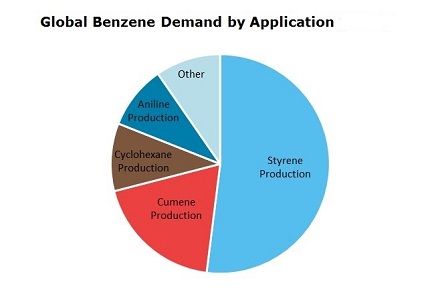
That benzene is used primarily to make styrene (50%), cumene (20%), cyclohexane (15%), and aniline (10%). Here's a percentage breakdown and here's a flow chart of its main derivatives. The main companies producing all this benzene are BASF, CP Chem, , and the other usual suspects.