| WTI Crude | $74.21/bbl | +1.5% |
| Brent Crude | $76.45/bbl | +1.6% |
| HH Nat Gas | $3.40/MMBtu | +1.2% |
| MB Propane | $1.04/gal | +2.7% |
| 3:2:1 Crack | $15.24/bbl | -12.9% |
These 3 companies want to clean plastic oil
Repsol, Axens, and IFPEN have jointly announced the development of a purification technology designed to process plastic-waste-based pyrolysis oil.
First, understand this:
One of the greatest advantages chemical recycling presents is that the waste plastic can be processed without having to do as much sorting. But not sorting still has drawbacks—you can end up with a pyrolysis oil that contains silicon, chlorine, diolefins, and metals. Petrochemical companies prefer to limit the amount of contaminants in their steam crackers, so they often dilute that oil with traditional feedstock and sell renewable polymers with a mass-balance approach.
So, they have a technology?
These three companies developed a process technology that removes those impurities from plastic-waste-based pyrolysis oil. The technology will first be demonstrated at one of Repsol's plants, and then licensed to other operating companies by Axens.
Read the press release here.
It's going to take an army to capture all this CO2
US-based oil and gas services company, Baker Hughes, has announced its intent to collaborate with Borg CO2 on a CO2-capture and sequestration project in Norway.
Who is doing what?
Borg CO2 is just a partnership between 18 industry partners to make the port of Borg a future CO2 loading terminal. To do so, Borg CO2 needs to coordinate the CO2-capture from all the sites in the area and make sure there is somewhere to put all of that CO2. That's why the partnership is working with Baker Hughes to capture that CO2 and Equinor, Shell, and TotalEnergies to store that CO2.
Some hard truths:
Those oil majors mentioned above have formed a joint venture a few months ago and put $680 million into it. While right now the plan is to just store all of that CO2 under the Norwegian Continental Shelf, it's easy to imagine how such an infrastructure could enable CO2 utilization in the future (like Covestro's CO2-based polyurethane).
Read the press release here.
Siemens is the electric backbone to this biochemical plant
Finnish forest industry company, UPM, has selected Siemens Energy to electrify, automate, and digitalize (EAD) the company's upcoming biochemicals facility in Germany.
Some context:
Last October, we saw UPM announce that it had begun construction of this facility. Once the $650 million site starts up next year it will process 220,000 tons of wood into mono-ethylene glycol (MEG), mono-propylene glycol (MPG), and renewable functional fillers (RFF). If you're interested, you can read a little about the history of using wood to produce chemicals here.
Connecting some dots:
On Wednesday we talked about how Origin Materials wants to produce paraxylene from wood. That paraxylene could be converted into PTA by the Amoco process and reacted with the MEG that UPM is going to produce at this site to make PET—one of the world's most popular (and petroleum-based) plastics. While bio-based chemicals don't solve the plastic waste issue, they are more sustainable and produce fewer CO2 emissions.
Read the press release here.
The Reboiler:
- Amazon Web Services is teaming up with Koch Industries
- Preem is making renewable gasoline from sawdust in Sweden
- Ellipsis Earth makes drones that are helping find ocean plastic
- It looks like ExxonMobil might layoff another 5-10% of its US workforce
- This realty group acquired some land on the Houston Ship Channel
MOTD: allylchloride
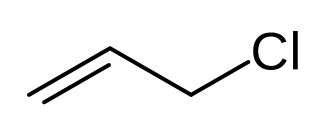
Today's MOTD might be more important than you expect, it's allyl chloride.
First produced by a couple of chemists named August in 1857, the world now produces over 1 million tons of the molecule each year. Shell was the first company to commercialize the technology by reacting propylene and chlorine at their Deer Park, TX site sometime in 1945. Dow Chemical got to it about a decade later in Freeport, TX.
Virtually all allyl chloride is produced by the chlorination of propylene. The vast majority of the stuff is used to make ECH (which ends up epoxy resins), but allyl chloride is also a feedstock for allyl alcohol, , and synthetic mustard oil.
The allyl chloride market is partially consolidated with the main producers including (but not limited to) Solvay, Osaka Soda, an Ineos subsidiary, and Olin.