
| WTI Crude | $73.11/bbl | -0.7% |
| Brent Crude | $75.22/bbl | +1.0% |
| HH Nat Gas | $3.36/MMBtu | +6.7% |
| MB Propane | $1.01/gal | +3.1% |
| 3:2:1 Crack | $17.48/bbl | +29.7% |
Origin might officially go public on Friday
Chemical start-up, Origin Materials, has announced that it expects to complete its pending merger with Artius Acquisition by this Friday.
A little background:
Origin is looking to convert cellulosic biomass into chloromethyl furfural (and a couple other molecules) with the primary goal of producing paraxylene and its derivatives. Paraxylene is typically produced by refineries, so the switch to woody biomass could help companies with lofty carbon-neutral goals achieve their objective.
What's next?
The public listing, initially announced in February, is expected to fully fund Origin until it becomes EBITDA positive. That could be a while from now—the company's initial demonstration plant in Ontario is currently under construction, so we're probably 2-3 years (that's a guess) from seeing full-scale production elsewhere.
Read the press release here.
Arkema plans to make bio-based battery binders
French chemical company, Arkema, has announced the launch of renewable polyvinylidene difluoride (PVDF) intended for the electric vehicle (EV) market.
What's going on here?
Arkema traditionally produces PVDF by the free radical polymerization of vinylidene fluoride. The haloalkane precursor required to make vinylidene fluoride can be produced in many different ways, but with Arkema's patent-pending it's not immediately obvious where renewable crude tall oil (CTO) enters the picture. That being said, we do know that the CTO (or a derivative of CTO) will be blended into an existing process through a mass-balance approach.
What does PVDF do for EVs?
PVDF, specifically Arkema's Kynar brand, has found itself most useful as an electrode binder or separator coating in lithium-ion batteries. The company actually has a helpful video you can check out here.
Read the press release here.
Bridgestone divested a rubber plant in China
Japanese tire manufacturer, Bridgestone, has announced the sale of its synthetic rubber plant in Huizhou, China to Taipei-based chemical company LCY Chemical.
Straight facts:
Bridgestone's plant in Huizhou employs about 130 people and is responsible for roughly $60 million in sales annually. The synthetic rubber that plant pumps out will now add to LCY's current offering of various styrene/butadiene and styrene/isoprene elastomers.
Why the sale?
According to Bridgestone, the decision follows the company's intent to rebuild the "earning power of its core business". Bridgestone's vertical integration from synthetic rubber production to final consumer product appears not to be worth the trouble—keep in mind that the sales from the plant ($60M) hardly compare to the company's total sales ($28B).
Read the press release here.
The Reboiler:
- Exxon's $7B plastics plant is seeing progress in Portland, Texas
- BASF's chemical recycling plan just got validated by Underwriters Laboratories
- Casale's ammonia technology was selected for a new plant in Uzbekistan
- Lukoil started up its isomerization unit at its Nizhny Novgorod Refinery
- The ACC thinks that North American plastic recycling rates need more clarity
MOTD: etbe
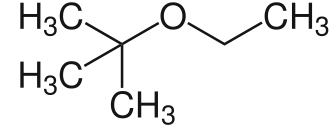
Today's MOTD deserves a round of applause, it's ethyl tert-butyl ether.
Formed by the acidic etherification of isobutylene with ethanol, ethyl tert-butyl ether (ETBE) is one of the few different gasoline oxygenates used today. Despite an annual production globally of over 3 million tons, this stuff is used almost exclusively in Western Europe and Japan.
In the US (and more recently in China) refineries are required to produce gasoline that contains 10% ethanol. That makes it the most popular octane booster, but that's not because it's the best for the job (check out this helpful chart). ETBE, which is made from ethanol, can be blended to much higher levels than ethanol (over 20%) and has other air quality benefits.
The main companies producing the world's ETBE are LyondellBasell, Total, Braskem, and quite a few more.