
| WTI Crude | $61.49/bbl | +0.9% |
| Brent Crude | $64.06/bbl | +0.5% |
| HH Nat Gas | $2.58/MMBtu | +2.4% |
| MB Propane | $0.90/gal | -0.2% |
| 3:2:1 Crack | $16.52/bbl | +3.2% |
Celanese will make methanol out of CO2 in Texas
US-based chemical corporation, Celanese, and Japanese firm, Mitsui Chemicals, have announced plans to use waste CO2 to produce methanol at their joint venture site in Clear Lake, Texas.
What are they doing?
Typically, methanol is produced by reacting carbon monoxide and hydrogen (syngas) over a catalyst. But if you can manage to hydrogenate CO2 instead of carbon monoxide (like what Sumitomo wants to strap onto its PDH technology) then you've got yourself a great way to reduce site CO2 emissions.
Extra green:
It's not just that the upgraded methanol unit will consume "an estimated 60 percent of currently vented process CO2 from the entire Clear Lake site". It was just a couple of months ago when Celanese signed a 15-year solar agreement to replace a third of this site's power requirements with renewables. Combine those two facts and you've got some very green methanol (and of course, all of its derivatives like acetic acid, VAM, and ethyl acetate).
Read the press release here.
Avantium's biobased plastic pre-order is going well
Netherlands-based sustainable chemicals company, Avantium, has secured two new offtake contracts for its planned FDCA plant.
What that means:
We last saw Avantium when the company scored about $7 million from the Netherlands' government. Avantium wants to build a one-of-a-kind plant to produce polyethylene furanoate (PEF) from biobased FDCA as a replacement for PET, but it wants to make sure that companies will actually buy the PEF it produces. Today's announcement is sort of like a pre-order—basically, two more companies promised to buy the new polymer.
What now?
With these two offtake agreements signed the company has managed to sell 30% of its new production before it has even broken ground. If the company wants to stick to its "plans to open" the plant by 2023 it will likely need to make a final investment decision by the end of the year. Flagship plants aren't built and started-up overnight!
Read the press release here.
Lummus' ethylbenzene technology secretly used in China
Process technology firm, Lummus Technology, has announced that its ethylbenzene (EB) production technology was selected (by a company that wishes not to reveal its name) for a new plant in China.
What are they making?
Lummus' EBOne technology produces EB in the same way that basically all of it is made—by reacting benzene and ethylene. While it wasn't spelled out in the announcement, this EB will probably be used to produce styrene (which of course becomes so many things).
So why choose Lummus?
Just because all of the world's EB is made by reacting the same molecules doesn't mean all EB is produced equally. Lummus' liquid phase process offers a lower benzene-to-ethylene ratio which means smaller equipment and fewer byproducts. That liquid phase technology competes with Badger's vapor phase technology that is responsible for half of the world's EB production.
Read the press release here.
The Reboiler:
- SABIC's partially renewable polycarbonate will be used to make eyewear lenses
- China will become the world's largest oil refiner by the end of the year
- BASF plans on spending up to $4.7 billion cutting its CO2 emissions
- This credit card producer will now offer a recycled PVC card
- Dow and Aramco made plans to market the products of their new JV
- Celanese plans to expand its acetyl capability in China and Germany
MOTD: ethane
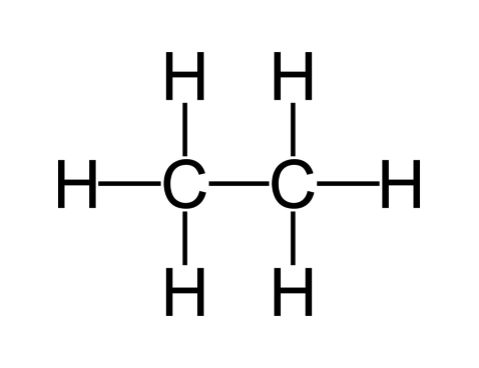
Today's MOTD is a personal favorite… ethane.
While Michael Faraday was able to synthesize the molecule back in 1834, it wasn't until this English chemist found it inside Pennsylvanian crude oil that we realized how much of it is out there.
Today, all of the ethane produced is either a component of natural gas or as a byproduct of petroleum refining. All of that ethane (with a few exceptions) is used as a steam cracking feedstock.
The main companies producing all of this ethane are the ones pumping it out of the ground upstream and the natural gas processors who supply the petrochemical companies.