| WTI Crude | $83.50/bbl | +1.0% |
| Brent Crude | $83.10/bbl | -1.2% |
| HH Nat Gas | $5.49/MMBtu | -7.1% |
| MB Propane | $1.38/gal | +1.3% |
| 3:2:1 Crack | $20.32/bbl | -1.9% |
BASF sold off its semiconductor helper
German chemical giant, BASF, divested its precision microchemicals business to semiconductor chemicals company, Entegris, for $90 million.
Precision microchemicals?
Inside of BASF's surface treatment business, which sits inside of its coatings division, lies a company wholly owned by BASF called Chemetall. Chemetall is known for making chemical mechanical planarization (CMP) slurries (which is basically a bunch of nano-sized abrasives dispersed in an acidic or basic solution).
What are CMP slurries for?
Making semiconductors is a very complex and lengthy process—but for the sake of this paragraph, you can think of it as a repetitive process of adding a layer, removing parts of that layer, and then adding another layer. The abrasives and chemicals in CMP slurries fall into the "removing parts of a that layer" bucket. They ensure that each layer goes on extremely flat.
Read the press release here.
Valero finished its renewable refinery expansion
San Antonio based refiner, Valero, has completed the construction of its renewable diesel and naphtha expansion at its refinery just outside of New Orleans.
Some context:
Valero isn't new to this refining renewables thing, they've been pumping out 275 million gallons of renewable diesel (~90%) and naphtha (~10%) from this site since 2013. A little while back they announced plans to bump the site's capacity to 735 million gallons (same ratios). During their Q3 announcements, they let us know that the construction of the expansion was complete and that start-up is in progress.
Wait, what are they making?
People often confuse renewable diesel with biodiesel—but the two are not the same. Valero is hydrotreating, isomerizing, and then distilling vegetable oils into two fractions: a lighter (C5-C10) naphtha fraction, and a heavier (C14-C20) diesel fraction. It's obvious how the diesel will be used (in trucks), but the naphtha could go a couple of different ways (polymers or gasoline).
Read the press release here.
Cemvita convinced Sumitomo to invest in it
Houston-based start-up, Cemvita Factory, has secured a strategic investment from Japanese chemical company, Sumitomo, during Cemvita's series A funding round.
What is Cemvita up to:
Cemvita has genetically engineered a microorganism capable of producing ethylene from CO2, water, and light. In a drastic oversimplification, the company has done this by taking "a gene from a banana" and incorporating it into an existing microorganism. In principle, this is possible because bananas, like all fruits, produce ethylene as they ripen (which is why we use the gas to rapidly ripen fruit).
Sumitomo's angle:
Much like Cemvita's other investors, notably Occidental Petroleum and Mitsubishi Heavy Industries, Sumitomo is interested in Cemvita's potential to produce various molecules (more than just ethylene) anywhere they can get CO2, water, and light (that's a lot of places). We'll have to see what this extra capital can do for Cemvita. They are expected to build a pilot plant with Occidental pretty soon.
Read the press release here.
The Reboiler:
- Petrofac is going to improve a refinery in Lithuania for $640 million
- Phillips 66 just bought the rest of Phillips 66 Partners
- Vopak opened up its new terminal for ExxonMobil and SABIC's new plant
- US chemical production was down 1.5% during September according to the ACC
- BASF is expecting a $700 million hit from these high natural gas
MOTD: etbe
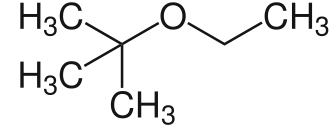
Today's MOTD isn't even that interesting, it's just ethyl tert-butyl ether.
Formed by the acidic etherification of isobutylene with ethanol, ethyl tert-butyl ether (ETBE) is one of the few different gasoline oxygenates used today. Despite an annual production globally of over 3 million tons, this stuff is used almost exclusively in Western Europe and Japan.
In the US (and more recently in China) refineries are required to produce gasoline that contains 10% ethanol. That makes it the most popular octane booster, but that's not because it's the best for the job (check out this helpful chart). ETBE, which is made from ethanol, can be blended to much higher levels than ethanol (over 20%) and has other air quality benefits.
The main companies producing the world's ETBE are LyondellBasell, Total, Braskem, and quite a few more.