| WTI Crude | $72.24/bbl | +2.8% |
| Brent Crude | $74.86/bbl | +3.2% |
| HH Nat Gas | $4.11/MMBtu | +4.3% |
| MB Propane | $1.09/gal | +2.2% |
| 3:2:1 Crack | $19.31/bbl | +4.7% |
POET can now make high purity ethanol in Indiana
The largest US ethanol producer, POET, has announced the start-up of a new purified ethanol plant at its site in Alexandria, Indiana.
What exactly are they making?
The purity of ethanol doesn't refer to the proof (ethanol to water ratio). It refers to the amount of impurities present in the mixture (stuff like methanol, acetaldehyde, etc.). Those impurities are there because ethanol isn't the only molecule bacteria spit out during fermentation. POET's new plant removes those impurities so that the company can produce two of the highest grades of ethanol—GNS and USP.
Bigger picture:
Products like hand sanitizer and various pharmaceuticals require that USP-grade ethanol. Historically, that grade of ethanol has been easier to produce synthetically by the hydration of ethylene. Currently, LyondellBasell is the only producer of that synthetic ethanol in all of North America. Now that POET is ramping up its high-purity ethanol production, you'll probably see POET steal some of LyondellBasell's market share.
Read the press release here.
Eastman wants to turn your car into molecules
American chemical company, Eastman Chemical, has announced a new partnership with USAMP and PADNOS to determine whether Eastman's molecular recycling technology can process automotive shredder residue (ASR).
The issue at hand:
Single-use plastics get a lot of heat for their environmental impact, but at the end of the day, we throw away our cars as well (when they stop working, of course). Each year the world generates roughly 25 million tons per year (extrapolating from this stat) of non-recyclable automotive waste we call ASR. On a mass basis, this stuff makes up about 10-20% of a car, but on a volume basis, it's closer to 50%. We're talking about the plastic dashboards, body parts, seat belts, airbags, etc.
Where Eastman comes in:
This mixture of plastics (which is contaminated with various inorganic matter) would be extremely difficult to sort and process mechanically. Eastman wants to mix that ASR in with the coal they gasify to produce a mixture of carbon monoxide and hydrogen (that's syngas). Once Eastman has the syngas they can use it to make methanol—which later becomes acetic acid and acetic anhydride.
Read the press release here.
Nouryon is moving its plant to keep roofs cool
Global specialty chemicals company, Nouryon, has decided to move its polymerization plant for expandable microspheres in China from Suzhou to Ningbo.
First, a little background:
Developed by Dow Chemical in the 1960s, these microscopic spheres are made of a thermoplastic shell that encapsulates a low boiling point liquid hydrocarbon. The little spheres (which Nouryon calls "the world's favorite secret ingredient") are used as lightweight fillers and blowing agents because the material can expand up to 60x in volume. That makes them useful in wine corks, food packaging, and roof cooling coatings (the most important application).
Okay, but why move the plant?
The production relocation (which, by the way, is just moving 150 miles South) is being done so that Nouryon can later increase the production capacity of the plant. That's possible because Nouryon's facility in Ningbo is characterized by "operational excellence" and additional "critical resources". The company wants to increase its capacity because these little spheres can help keep roofs cool—an AC bill cost reduction marketed as sustainability.
Read the press release here.
The Reboiler:
- TotalEnergies and Technip Energies are partnering on LNG
- McDermott is going to treat spend caustic at this polyethylene plant
- The US EIA imformed us about US crude oil exports reaching record highs
- Houston's KBR will build two nitric acid plants in Israel
- Group14 Technologies just formed a JV with SK Materials to produce lithium-silicon battery materials
MOTD: vam
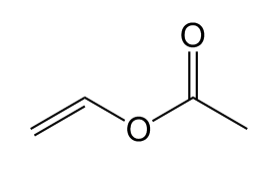
Today's MOTD deserves a round of applause, it's vinyl acetate.
First produced by a German chemist in 1912, the world now makes nearly 8 million tons of vinyl acetate (often called vinyl acetate monomer—VAM) each year.
As long as that VAM is being produced outside of China you can be confident it's made by reacting ethylene and acetic acid (31% of all acetic acid is used to make VAM). Companies in China produce VAM from acetylene (just like how that German chemist did it a century ago).
We make VAM not because it's super useful on its own, but because of all the things we can produce with it. About a third of all VAM is used to make PVAc (wood glue), another third for (contact lenses), and the rest becomes , EVOH, and VAE.
Aside from China, the main producers of VAM are Celanese, Dow Chemical, and LyondellBasell among others.