| WTI Crude | $74.21/bbl | -0.5% |
| Brent Crude | $76.77/bbl | -0.5% |
| HH Nat Gas | $3.70/MMBtu | -0.3% |
| MB Propane | $1.09/gal | -1.4% |
| 3:2:1 Crack | $16.93/bbl | +4.4% |
TotalEnergies totally wants to reduce CH4 emissions
French oil major, TotalEnergies, and satellite company, GHGSat, have announced a new partnership that aims to reduce methane emissions.
A little context:
TotalEnergies, previously known as Total, is one of the world's largest oil & gas corporations. The extraction, processing, and storage of those petroleum-based resources go hand in hand with (unintentional) methane leaks. But methane isn't visible to the naked eye, so plugging leaks is never super easy. TotalEnergies wants to stop those leaks because it's good for the environment—and good for business (would you want your product exiting to the atmosphere?).
So, what are they doing?
The two companies want to use GHGSat's satellites to detect potential methane leaks at TotalEnergies' offshore facilities and confirm them with a spectrometer drone. TotalEnergies hopes that the partnership will help them "ensure that methane emissions are close to zero". That's important because methane can trap up to 80 times more heat than CO2 for the first two decades in the atmosphere.
Read the press release here.
This CO2 start-up got some cash
CO2 utilization start-up, Twelve (formerly known as Opus 12, has secured a $57 million Series A funding round.
What they are trying to do:
Twelve has developed a CO2-reducing catalyst that can be added to the cathode of a PEM electrolytic cell. By combining water, CO2, and a little electricity the company can produce methane and other chemicals (such as ethylene).
What's next:
According to Twelve, the "new funding is taking Twelve to a critical inflection point where we can scale our technology to any capacity or customer application, and to suit any product demand". You can read more about the company and its partnerships on GreenBiz and Fast Company.
Read the press release here.
Repsol is going to make way more LLDPE and PP
Spanish petroleum company, Repsol, is planning to build a new linear low-density polyethylene (LLDPE) and polypropylene (PP) plant at its site in Sines, Portugal.
Some context:
Repsol hasn't made PP at this site since it closed a plant there in 1992. Now, after further integrations, Repsol can start producing PP economically again. The company already operates a naphtha steam cracker at this site which pumps out 410,000 tons of ethylene, 215,000 tons of propylene, and 50,000 tons of butadiene each year—so the two new plants will take some of that captive.
The details:
For the price of $780 million, Repsol will start producing 300,000 tons per year of both LLDPE and PP when the plants start-up in 2025. That additional polymer capacity is being built for "highly specialized applications aligned with energy transition in the pharmaceutical, automotive and food industries".
Read the press release here.
The Reboiler:
- Shell decided to sell off what its share of this German refinery
- Shell also made some progress on its huge petrochemical plant in Pennsylvania
- Evonik just inaugurated the world's largest polyamide 12 complex
- Bostik finally unveiled a new polyurethane sealants line
- Mitsubishi Chemical licensed a patent for biobased polyester to Kuraray
MOTD: mdi
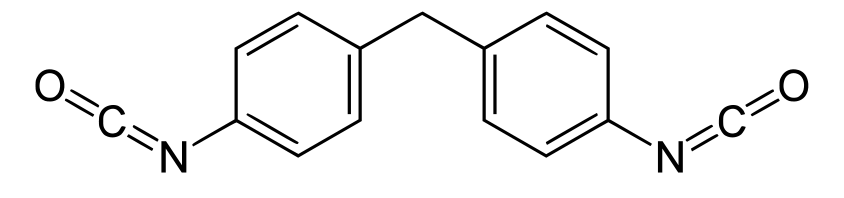
Today's MOTD is the best one yet: methylene diphenyl diisocyanate.
This mouthful of a molecule is commonly referred to as MDI, and it's one of the most popular diisocyanates on the market. MDI has only been around since the middle of the 20th century, but now the world is producing some 10 million tons of the stuff each year.
MDI is produced by reacting a couple aniline molecules with formaldehyde. Pretty much all of it is used to produce polyurethanes—a class of polymers formed by reacting an isocyanate with a polyol. Besides the countless applications for polyurethanes, MDI also finds itself as a binder in composite wood products (think of the type of wood Ikea furniture is made of).
The main producers of this good stuff are BASF, Covestro, Huntsman, and Dow Chemical. About half of all MDI produced is produced in China alone.