| WTI Crude | $52.25/bbl | +0.0% |
| Brent Crude | $54.21/bbl | -1.1% |
| HH Nat Gas | $2.86/MMBtu | +0.0% |
| MB Propane | $0.96/gal | +0.0% |
| 3:2:1 Crack | $12.36/bbl | +0.0% |
Chevron throws some cash at Blue Planet
California-based petroleum corporation, Chevron, has announced a Series C investment in a start-up that manufactures and develops carbonate aggregates with the help of carbon capture.
What are they doing?
The start-up, Blue Planet, is capturing CO2 from flue gas by contacting it with ammoniated water. That carbonated solution is then used to form a carbonate mineral coating over a small rock particle. The result is a synthetic limestone rock (which is the main component of concrete). Here's a basic process flow diagram if you're into that sort of thing.

Why is Chevron interested?
Chevron, like most petroleum companies, is looking to reduce its environmental impact by working towards net-zero emissions. Blue Planet's solution (which is similar to one we've seen before) doesn't require "CO2 purification and enrichment prior to use which can reduce cost and unit energy consumed during capture". That makes it an attractive investment for a company facing intensified pressure from investors to reduce emissions and provide more sustainable energy.
Read the press release here.
Mura gets exclusive with KBR
US-based EPC company, KBR, has been selected by process technology company, Mura Technology, as the exclusive licensing partner for Mura's proprietary chemical recycling method.
First, some background:
Mura has developed a technology that uses supercritical water to convert mixed plastic waste into a useful hydrocarbon product. The process depolymerizes plastic waste, splits the water molecules, and uses the available hydrogen to produce a mixture of hydrocarbons. That mixture can then be distilled into naphtha, distillate gas oil, heavy gas oil, or heavy wax residue (which can be upgraded into plastics or other chemicals).
What the agreement means:
Mura's technology has yet to be seen at full-scale—but that's set to change early next year. The process technology company can't build plants on its own, so it's bringing in KBR to handle the "studies, basic engineering, technical services, proprietary equipment and modules for the Cat-HTR technology.". Together the companies can approach manufacturing firms with a turnkey solution.
Read the press release here.
Avient to expand plastic coloring in Vietnam
Specialized polymers company, Avient, has announced that it will be expanding its existing production capabilities for color concentrates at its Binh Duong site in Vietnam by next month.
Some context:
Avient, formerly known as PolyOne, changed its name last summer after acquiring Clariant's masterbatch business. The business it acquired from Clariant was known for offering color and additive concentrates for plastics. It's safe to say that Avient's announcement is the realization of that acquisition.
Going a little deeper:
The purpose of coloring plastics is to enhance the market appeal of those plastics, and as consumption grows "top brands focus on novel color solutions". The expansion will "improve speed-to-market and service level for local customers" in Vietnam (where the plastic industry is seeing an annual growth rate of 16-18%). While those colors are good for business, they can be a pain for plastic recyclers—just something to think about.
Read the press release here.
The Reboiler:
- Total leaves the American Petroleum Institute because of climate disagreement
- McKinsey thinks aggregate fossil fuel demand will peak in 2027
- Sumitomo made a donation to support plastic recycling education
- Linde to build the world's largest PEM electrolyzer
- Solvay’s polymer membranes hope to capitalize on hydrogen
MOTD: bisphenola
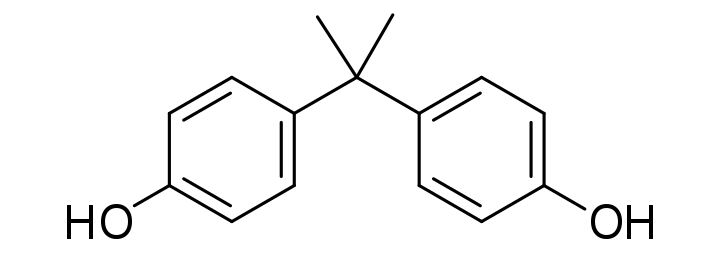
Today's MOTD is the one you've been dreaming about… bisphenol A.
You've seen the label and you've probably heard a thing or two about bisphenol A (BPA). The mass production of this controversial molecule got started in the 1950s by the condensation two equivalents of phenol (bisphenol) and acetone (A).

Despite BPA's recognition as an artificial estrogen in the 1930s, the molecule's debatable health consequences have been outweighed by its ability to produce useful polycarbonates and vinyl ester resins. It is now known that trace amounts of BPA can be leached from the materials it is transformed into—when they are exposed to hard use (scratching) or high temperatures (your microwave and dishwasher).
In any case, the world now produces nearly 10 million tons of the molecule each year. Most of that production is done by Covestro, DuPont, Mitsui Chemicals, and LG Chem.